The Accident Claims Process
Understand what may happen from your first call and vehicle recovery through to liability assessment, repairs, replacement transport and claim completion.
A Clear Process from Accident to Resolution
No two accident claims follow exactly the same route. A straightforward collision with clear evidence may progress quickly, while disputed liability, unavailable parts or complicated damage can result in a longer process.
The following stages provide a realistic overview of how an eligible non-fault accident case may be managed.
Information to Have Ready
Stage 1: Initial Contact
We collect your contact, accident, vehicle, insurance and third-party information.
You may be asked for:
- Registration numbers
- Accident location
- Photographs
- Dashcam footage
- Witness details
- Insurance information
- Police reference
Stage 2: Vehicle Recovery
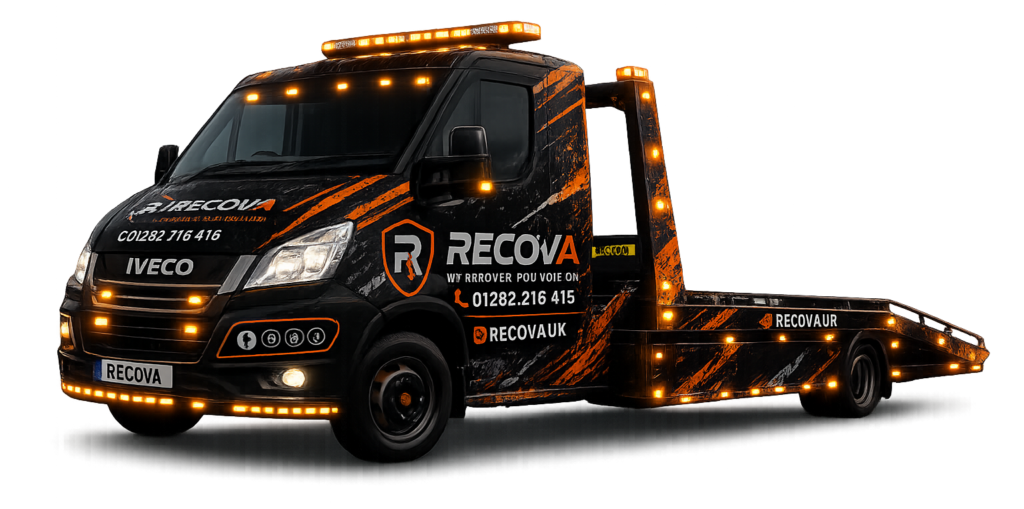
Where the vehicle cannot be driven safely, Recova arranges collection from the accident scene or its current location.
The vehicle may be transported to:
- A secure storage facility
- An assessment centre
- A repair facility
- Your home
- Another agreed location
Stage 3: Claim and Eligibility Assessment
The relevant provider reviews:
- Accident circumstances
- Available evidence
- Third-party identity
- Insurance status
- Liability prospects
- Repair requirements
- Replacement vehicle need
Nothing should proceed until the customer understands which company is providing each service and the agreement being offered.
Stage 4: Liability Investigation
The involved insurers or representatives consider the accident accounts and supporting evidence.
Possible outcomes include:
- Liability accepted
- Liability denied
- Liability disputed
- Split liability proposed
- Further evidence requested
Stage 5: Vehicle Inspection
An engineer or repairer assesses the damage and determines whether the vehicle appears economically repairable.
The insurer or claim provider may then authorise repairs, request further information or consider the vehicle a total loss.
Stage 6: Repairs or Settlement
Where repairs are approved, the vehicle enters the repair process. Where it is considered uneconomical or unsafe to repair, a settlement based on the relevant valuation process may be proposed.
The Financial Ombudsman notes that insurers commonly consider writing a vehicle off where repair costs are approximately 60–70% of its pre-accident value, although this is not a fixed rule and individual decisions can differ.
Stage 7: Completion
The claim concludes when the vehicle has been repaired or the relevant settlement has been agreed, outstanding services have ended and the claim provider has completed its recovery process.
How Long Does an Accident Claim Take?
There is no universal timescale.
The process may be affected by:
- Liability disputes
- Delayed insurer responses
- Availability of evidence
- Vehicle inspection times
- Parts availability
- Repairer capacity
- Hidden damage
- Vehicle valuation disputes
- Replacement vehicle requirements
- Personal injury or legal issues
- Uninsured or unidentified third parties
Customers should receive meaningful updates when there are delays rather than being left without information.

Your Responsibilities During the Claim
You may need to:
- Provide accurate information
- Preserve photographs and dashcam footage
- Respond to reasonable requests
- Make the vehicle available for inspection
- Report changes in your circumstances
- Cooperate with cost recovery
- Avoid unnecessarily extending replacement vehicle use
- Return any replacement vehicle when requested under the agreement
- Notify the provider if your own vehicle becomes available
- Read all contracts before signing
Need Vehicle Recovery Now?
Whether you’ve broken down, been involved in an accident or need a vehicle transported, Recova is ready to help. Call our team now for fast, professional vehicle recovery across Burnley, Lancashire and the surrounding areas.